

Search for AI automation companies and the results mix three completely different purchases: software platforms you license, consultancies you hire to implement them, and managed service providers who run the result. Lists that rank a workflow tool alongside a global consultancy are comparing a product with a professional services contract. They are not alternatives, and most businesses eventually buy two of the three.
There is a second problem. Gartner estimates that of the thousands of vendors marketing agentic AI, only around 130 genuinely offer it, describing the rest as "agent washing" - rebranding existing chatbots, assistants and robotic process automation as agentic without substantial agentic capability. It also predicts that more than 40% of agentic AI projects will be cancelled by the end of 2027, citing escalating costs, unclear business value and inadequate risk controls.
This guide separates the categories, names the companies worth knowing in each, and sets out what the evidence says actually determines whether an automation programme pays back. 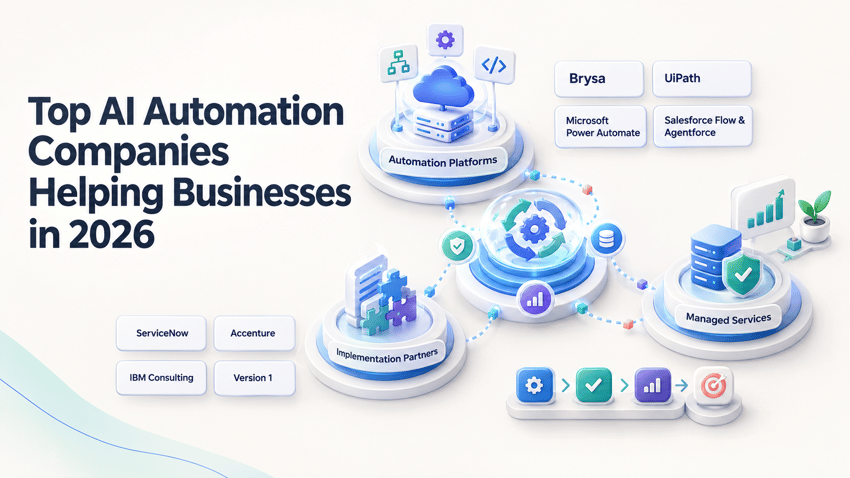
The uncomfortable finding behind every AI automation shortlist
McKinsey's Global Survey on AI, published in August 2026 and based on 1,719 respondents across 97 nations, found that nearly nine in ten organisations now use AI regularly in at least one business function. Financial impact has not kept pace. Just 37% attribute any EBIT impact to AI, essentially unchanged on the previous year, and only 6% qualify as high performers, defined as attributing at least 5% of EBIT to AI. That 6% figure did not move at all year on year.
The difference between the 6% and everyone else is not which vendor they chose. Nearly three-quarters of high performers had fundamentally redesigned workflows, against roughly a quarter of other respondents. They were more than three times as likely to be scaling agents across most business functions.
Scaling is also uneven by size. Among organisations above $1bn in revenue, 40% report scaling AI agents, up from 27% a year earlier. Among smaller organisations the figure sat flat at 22%. Meanwhile 20% of respondents said AI operating costs, including token consumption, had constrained their use — a cost line that barely featured in automation business cases two years ago.
The practical implication: the selection question that matters is not "which company is best" but "which company will redesign the process rather than automate the existing one". A vendor that deploys quickly against your current workflow is selling you the thing that did not work for the other 94%.
The three categories of AI automation companies
Before shortlisting, it is worth being clear about which of these is being bought. Confusing them is the most common reason procurement goes wrong.
|
Category |
What they sell |
Priced as |
Choose when |
|
Automation platforms |
Software your team configures and runs |
Licence or consumption, annually |
You have internal capability to build and maintain |
|
Implementation partners |
Consulting and delivery on a platform |
Project fee or day rate |
You need the process designed and built |
|
Managed service providers |
Ongoing operation and support of automations |
Monthly retainer |
You want to own the outcome, not the upkeep |
Most organisations buy a platform and a partner. The partner is usually the larger determinant of whether the programme works, because platform capabilities across the major vendors have converged considerably, while delivery quality has not.
The 8 top AI automation companies in 2026
The list below mixes platforms and service firms deliberately, because a real shortlist usually does. The type column states which is which, so the two are not compared on the same terms.
Disclosure: Brysa publishes this article and appears first. The entry states what it does and who it suits, on the same basis as every other entry, and readers should weigh it accordingly.
|
Company |
Type |
Best suited to |
Main constraint |
|
Brysa |
Implementation partner |
Salesforce and Agentforce automation, revenue operations |
Strongest inside the Salesforce estate |
|
UiPath |
Platform |
Automation spanning mixed and legacy systems |
Needs skilled build and maintenance capability |
|
Microsoft Power Automate |
Platform |
Microsoft-centred organisations, broad internal use |
Governance sprawl without a managed catalogue |
|
Salesforce Flow and Agentforce |
Platform |
Automation on CRM records and customer processes |
Strongest inside the Salesforce boundary |
|
ServiceNow |
Platform |
Cross-department request and approval workflows |
Heavier than needed for simple task automation |
|
Accenture |
Global partner |
Multi-country, multi-platform programmes |
Commercial scale rules out smaller projects |
|
IBM Consulting |
Global partner |
Data-heavy automation and hybrid cloud estates |
Data work often precedes automation value |
|
Version 1 |
Specialist partner |
Estates spanning Oracle, Microsoft, AWS and ServiceNow |
UK and Ireland centred |
1. Brysa — Salesforce and Agentforce automation
Type: implementation partner. A UK-based Salesforce consulting and digital transformation partner working across Sales Cloud, Service Cloud, Marketing Cloud, Data Cloud, Revenue Cloud, Experience Cloud, Commerce Cloud, Field Service Lightning, Slack and Agentforce, with Accounting Seed for finance processes. Services span Salesforce consulting, implementation and ongoing maintenance.
Relevant to the McKinsey finding above, its fixed-scope entry points include an Agentforce data readiness assessment, reflecting the fact that agentic automation reasoning over poor underlying data tends to fail regardless of platform. The sequencing argument is set out in its work on building an AI data foundation.
Best suited to: organisations running Salesforce, or planning to, that want customer-facing and back-office workflows automated on one platform rather than bolted together across several.
2. UiPath — Automation across mixed and legacy systems
Type: platform. The best-known enterprise automation platform, built on robotic process automation foundations and extended into agentic orchestration. Strong where automation must span many systems, including legacy applications with no usable API. Carries the deepest partner and developer ecosystem of the RPA-derived platforms, which matters for hiring and for finding implementation help.
Best suited to: estates where automation has to reach older systems that will not be replaced soon.
3. Microsoft Power Automate — Automation inside the Microsoft estate
Type: platform. Embedded in Microsoft 365 and Azure, which makes it the default where an organisation already runs on Microsoft. Licensing is often partly covered by existing agreements, and the Power Platform gives business users a low-code route. The trade-off is that governance needs deliberate attention: easy creation produces sprawl without a managed catalogue of what exists and who owns it.
Best suited to: Microsoft-centred organisations wanting broad internal participation in building automations.
4. Salesforce Flow and Agentforce — Automation on CRM data
Type: platform. For organisations running Salesforce, much customer-facing automation can be built natively rather than bolted on, with Flow handling deterministic process automation and Agentforce providing the agentic layer over CRM data. The advantage is that automation operates on the same records as the business process, avoiding a separate integration surface. The constraint is that it is strongest inside the Salesforce boundary.
Best suited to: organisations where Salesforce is the system of record for the processes being automated.
5. ServiceNow — Enterprise service and approval workflows
Type: platform. Originating in IT service management and extended into enterprise workflow across HR, customer service and operations. Particularly strong for cross-departmental request and approval workflows needing a service catalogue, routing and SLA tracking alongside the automation itself. Heavier than necessary where the requirement is simple task automation.
Best suited to: structured service and approval processes that cross several departments.
6. Accenture — Large, multi-country automation programmes
Type: global implementation partner. Operates one of the largest technology and consulting practices globally, with intelligent automation services spanning strategy, implementation and managed operations. Suited to programmes running across multiple countries, business units and platforms at once, with the commercial scale that implies.
Best suited to: enterprises running automation as a global programme rather than a departmental project.
7. IBM Consulting — Data-heavy and hybrid cloud automation
Type: global implementation partner. Combines automation delivery with data modernisation and hybrid cloud work, and holds its own automation and orchestration products alongside the services business. Tends to fit situations where the automation problem is substantially a data problem and the underlying estate needs attention first.
Best suited to: data-intensive enterprises with hybrid or multi-cloud infrastructure.
8. Version 1 — Multi-platform enterprise estates
Type: specialist implementation partner. A UK and Ireland technology services firm of roughly 3,300 people, holding partnerships across Oracle, Microsoft, AWS, Red Hat, OutSystems and Snowflake, and accredited with ServiceNow. Useful where processes span several major enterprise platforms and a single partner is wanted across all of them, at a commercial scale the global firms will not match.
Best suited to: mid-market and enterprise organisations with processes spread across several platforms.
Also worth shortlisting
Four other groups are credible and were left out of the main list only to keep it usable.
- Automation Anywhere and SS&C Blue Prism. Both compete directly with UiPath in large-scale transactional automation. Blue Prism, founded in the UK in 2001 and now owned by SS&C Technologies, leans towards centrally governed deployment where auditability matters more than speed of rollout.
- Integration-led tools: Workato, Zapier, Make and n8n. Frequently underestimated. For a large share of real business workflows these are sufficient and considerably cheaper than an enterprise platform, and n8n can be self-hosted where data residency or cost control rules out a managed service.
- Deloitte, Capgemini, Infosys and Cognizant. Large global services firms delivering automation inside broader technology and operations engagements, commercially efficient where automation folds into a managed services contract already in place.
- Kainos and Proservartner. Narrower specialists: Kainos for Workday-centred process automation and public sector delivery, Proservartner for intelligent automation and shared-services design in back-office functions.
How to tell genuine AI automation from agent washing
Gartner's estimate that only around 130 vendors genuinely offer agentic AI makes vendor diligence unusually important. The following checks are practical and quick.
- Ask what the agent does when it is uncertain. A genuine agentic system has defined escalation behaviour. A rebranded chatbot either guesses or fails silently.
- Ask to see the audit trail for a decision. If the vendor cannot show why a particular action was taken, the system cannot be governed and will not survive a regulatory conversation.
- Ask what happens on a model change. Agentic behaviour shifts when the underlying model is updated. Vendors without a regression testing answer have not run this in production for long.
- Ask for the token or consumption cost at your expected volume. One in five McKinsey respondents reported AI running costs constraining use. A vendor unwilling to model this is deferring a cost you will meet later.
- Ask which parts are deterministic. Mature systems use rules where rules suffice and models only where judgement is needed. "It is all AI" is a warning sign, not a feature.
- Ask what workflow redesign they expect you to do. Given that workflow redesign separates the 6% from everyone else, a partner who says none is required is either not paying attention or telling you what you want to hear.
What AI automation costs
Three cost layers are routinely conflated, and the second and third are where budgets break.
- Platform licensing. Ranges from free tiers on integration tools to six-figure annual commitments for enterprise platforms, usually priced per user, per bot or per consumption unit.
- Implementation. Typically the largest first-year line. Integration work with existing systems consistently accounts for the biggest share and is the item most often underscoped in proposals.
- Running costs. Model and token consumption, monitoring, and maintenance when underlying systems change. This is the line that surprised one in five organisations in the McKinsey data and belongs in the business case from the start.
A realistic business case models all three over three years. One that shows only licence cost against projected savings is not a business case.
Why AI automation projects get cancelled
Gartner attributes the projected cancellation rate to escalating costs, unclear business value and inadequate risk controls. In practice, these surface as recognisable patterns.
- Automating the existing process. The workflow redesign gap in the McKinsey data is the single clearest predictor of whether automation produces financial impact.
- Poor data underneath. Agentic systems reasoning over inconsistent or duplicated records produce confident wrong answers. Technical debt in the underlying platform tends to surface as an AI problem long after it became a data problem.
- No measurement baseline. Without agreed before-and-after metrics, value becomes contested at renewal and the programme loses its sponsor.
- Pilot design that cannot scale. Proofs of concept built without production constraints — security review, data governance, support model — stall at the point of scaling, which is where Gartner says most cancellations happen.
- No owner after go-live. Automations decay as the systems around them change. Unowned automations quietly stop being trusted, and then quietly stop being used.