

The manufacturing sector is increasingly adopting AI, automation, cloud platforms, IoT, digital twins, advanced analytics, and connected enterprise systems. Current industry research highlights a shift toward integrated architectures connecting MES, PLM, ERP, IoT, AI, and digital twins to support more connected and intelligent manufacturing operations. Recent developments in AI adoption in manufacturing further highlight the growing focus on AI-driven industrial transformation.
For manufacturers, digital transformation can involve far more than replacing legacy software. It can include modernising production processes, connecting IT and OT environments, improving supply-chain visibility, automating workflows, using AI for decision-making, and creating better connections between engineering, operations, sales, finance, and customer-facing teams.
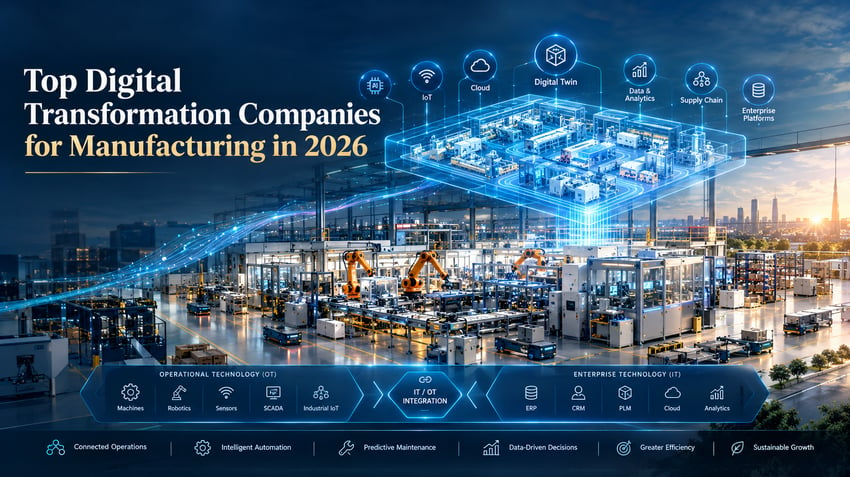
Top Digital Transformation Companies for Manufacturing in 2026
1. Brysa
Overview:
Brysa is a UK-based digital transformation consultancy specialising in Salesforce, AI, workflow automation, and business-process transformation. Its website describes its focus on turning complex Salesforce transformations into smoother digital journeys and helping organisations move from fragmented platforms, siloed data, and manual processes toward integrated and automated workflows.
Brysa is not a traditional industrial automation or factory-engineering company. Its relevance to manufacturing digital transformation is primarily around the business systems, customer processes, data, automation, and enterprise workflow layer.
Relevant capabilities include:
- Salesforce consulting and implementation
- AI and automation
- Workflow automation
- CRM transformation
- Data integration
- Business-process optimization
- Digital transformation
- Salesforce Agentforce
- Revenue and quote-to-cash transformation
For manufacturers, these capabilities can be relevant to areas such as sales operations, customer management, quoting, commercial processes, service workflows, and connections between business teams and enterprise systems.
Brysa's Revenue Cloud readiness offering, for example, focuses on quote-to-cash processes spanning pricing, configuration, approvals, sales, operations, and finance.
Key strengths: Salesforce, AI, automation, workflow transformation, and business-system integration.
Typical organisations served: Organisations undertaking Salesforce and digital transformation programs, with particular experience in media, engineering, and nonprofit sectors.
2. Accenture
Overview:
Accenture has a dedicated digital engineering and manufacturing practice covering engineering, production, operations, supply chains, connected products, intelligent assets, and automation.
Its manufacturing services use technologies including data, AI, cloud, digital twins, automation, robotics, and connected systems to support manufacturing transformation.
Relevant capabilities:
- Digital manufacturing
- Smart factories
- AI and automation
- Digital twins
- Supply-chain transformation
- Intelligent asset management
- Engineering transformation
- Advanced robotics
Accenture also announced in June 2026 that it agreed to acquire Industries eXcellence Group to strengthen its capabilities around Siemens software and automation solutions for manufacturing.
Key strengths: Large-scale manufacturing transformation, AI, digital engineering, automation, and IT/OT integration.
3. Deloitte
Overview:
Deloitte supports manufacturing transformation through consulting, technology integration, analytics, and industrial platforms. Its alliance with Siemens combines Deloitte's consulting and implementation capabilities with Siemens technologies including Teamcenter PLM, Insights Hub IoT, and Opcenter MES.
Relevant capabilities:
- Smart manufacturing
- Manufacturing execution systems
- Product lifecycle management
- IoT
- Digital twins
- Data analytics
- IT/OT integration
- Low-code applications
Deloitte's manufacturing approach can connect product development, manufacturing operations, data, and enterprise processes.
Key strengths: Manufacturing strategy, industrial technology, analytics, and enterprise transformation.
4. Capgemini
Overview:
Capgemini provides digital transformation services across manufacturing, combining consulting, engineering, cloud, data, AI, and industrial technology.
Its manufacturing capabilities are particularly relevant for companies looking to modernise operations while connecting production systems with enterprise technology.
Relevant capabilities:
- Smart manufacturing
- Industrial IoT
- AI and analytics
- Digital twins
- Cloud transformation
- Supply-chain transformation
- Engineering services
- Manufacturing data platforms
Key strengths: Digital engineering, technology integration, cloud, data, AI, and industrial transformation.
Typical organisations served: Global manufacturers across automotive, aerospace, industrial, consumer products, life sciences, and other sectors.
5. IBM Consulting
Overview:
IBM Consulting provides digital transformation and technology services that can support manufacturers with cloud, AI, data, automation, and enterprise modernisation.
Manufacturing transformation increasingly requires connecting operational technology with enterprise systems and applying AI to production, maintenance, supply chains, and decision-making.
Relevant capabilities:
- AI and data
- Hybrid cloud
- Intelligent automation
- Supply-chain transformation
- Asset management
- Enterprise modernization
- IoT and connected operations
- Digital manufacturing
Key strengths: AI, hybrid cloud, enterprise technology, data, and automation.
Typical organisations served: Large manufacturers and industrial organisations undergoing technology and operational transformation.
6. Siemens
Overview:
Siemens is a major industrial technology provider with capabilities spanning industrial automation, manufacturing software, digital twins, product lifecycle management, industrial IoT, and factory technology.
Its portfolio can support manufacturers across product development, production planning, factory operations, and asset management.
Relevant capabilities:
- Industrial automation
- Digital twins
- Product lifecycle management
- Manufacturing execution
- Industrial IoT
- Factory automation
- Industrial software
- Digital engineering
Siemens' technology is also increasingly integrated into broader consulting and transformation ecosystems. Deloitte's manufacturing alliance with Siemens, for example, combines Siemens manufacturing platforms with Deloitte's consulting and delivery capabilities.
Key strengths: Industrial technology, automation, digital twins, manufacturing software, and engineering.
Typical organisations served: Large manufacturers and industrial enterprises across automotive, aerospace, electronics, chemicals, energy, pharmaceuticals, and industrial equipment.
7. Tata Consultancy Services (TCS)
Overview:
Tata Consultancy Services provides digital transformation services across manufacturing and industrial sectors, with capabilities covering cloud, AI, IoT, engineering, enterprise applications, and supply-chain transformation.
Relevant capabilities:
- Manufacturing transformation
- AI and analytics
- Industrial IoT
- Cloud
- Supply-chain transformation
- Enterprise applications
- Engineering services
- Automation
Key strengths: Global technology delivery, enterprise transformation, AI, cloud, engineering, and industrial technology.
Typical organisations served: Large manufacturing and industrial enterprises across automotive, engineering, consumer products, and other sectors.
Digital Transformation Companies for Manufacturing Comparison
|
Company |
Key Focus |
Relevant Manufacturing Capabilities |
|
Brysa |
Business and digital transformation |
Salesforce, AI, automation, CRM, workflows, data integration |
|
Accenture |
End-to-end manufacturing transformation |
AI, digital twins, automation, engineering, supply chain |
|
Deloitte |
Manufacturing consulting and technology |
MES, PLM, IoT, analytics, IT/OT transformation |
|
Capgemini |
Digital engineering and smart manufacturing |
AI, IoT, cloud, digital twins, engineering |
|
IBM Consulting |
AI and enterprise modernisation |
AI, cloud, automation, data, connected operations |
|
Siemens |
Industrial technology |
Automation, PLM, MES, digital twins, industrial IoT |
|
TCS |
Enterprise and technology transformation |
AI, cloud, IoT, engineering, supply chain |
How to Choose a Digital Transformation Company for Manufacturing
1. Manufacturing Industry Expertise
Look for providers that understand manufacturing processes rather than only general enterprise technology. Experience across production, engineering, supply chain, quality, maintenance, and operations can be important.
2. IT and OT Integration
Manufacturers often operate with a mixture of enterprise IT systems and operational technology. A transformation partner should understand how systems such as ERP, MES, PLM, SCADA, IoT platforms, and CRM can work together.
3. AI and Automation
Evaluate how the provider approaches AI, intelligent automation, predictive analytics, robotics, and AI-enabled decision-making.
4. Legacy-System Modernisation
Many manufacturers cannot replace every existing system at once. A capable transformation partner should be able to integrate existing technology while creating a practical modernisation roadmap.
5. Data and Digital Twins
Data integration and digital twins can provide manufacturers with greater visibility into products, assets, and production processes. Providers should be evaluated on their ability to establish the data architecture needed to support these technologies.
6. Implementation Capability
A transformation strategy needs to translate into implementation. Consider experience with system integration, change management, technology deployment, training, and ongoing support.
Final Thoughts
Manufacturing digital transformation is increasingly moving toward connected, data-driven, and AI-enabled operations. The right technology partner depends on whether the primary requirement involves factory automation, industrial software, enterprise systems, supply-chain transformation, AI, or business-process modernisation.
Accenture, Deloitte, Capgemini, IBM Consulting, Siemens, and TCS provide broad manufacturing and technology capabilities across different parts of the transformation landscape.
Brysa brings a more focused capability around Salesforce, AI, workflow automation, data integration, and business transformation. For manufacturers looking to modernise customer-facing and commercial processes, automate workflows, connect business systems, or improve Salesforce operations, these capabilities can form part of a broader digital transformation strategy