

There is a reason we always liked CPQ at Brysa. It produced consistent quotes. Passed them further down the process. Converted into contracts and eventually invoices. Months later, that same invoice would be renewed. Repeatability was its biggest strength.
Now here’s the catch. When you trace a single deal through this process, you will see several points where a number could be wrongly changed. This could lead to utter chaos.
For instance, a client once told me this.
“A one-time discount became recurring because the invoice was copied to build the renewal.”
This is just one of many examples. A change in the middle of the contract failing to appear on the next bill because it was not in the original quote…An increased volume mentioned in the contract did not happen because someone forgot...The stories are endless.
Now it is very difficult to identify these as the root cause of a revenue leak. Particularly true when you look at them in-silo. But together, they create an impression that a particular deal is performing poorly.
Now the truth is none of this is CPQ’s fault. The platform isn’t supposed to be responsible for anything after the quotation. And that’s why the shift to Revenue Cloud makes complete sense.
Revenue Cloud solves this problem in a unique way. It doesn’t treat quoting as a standalone process. It treats the entire commercial lifecycle as one continuous record. The quote is no longer the starting document. It is the pillar that contracts, orders, billing, renewals and revenue recognition stand on. In other words, every downstream process works from the same commercial agreement. No more duplicate versions.
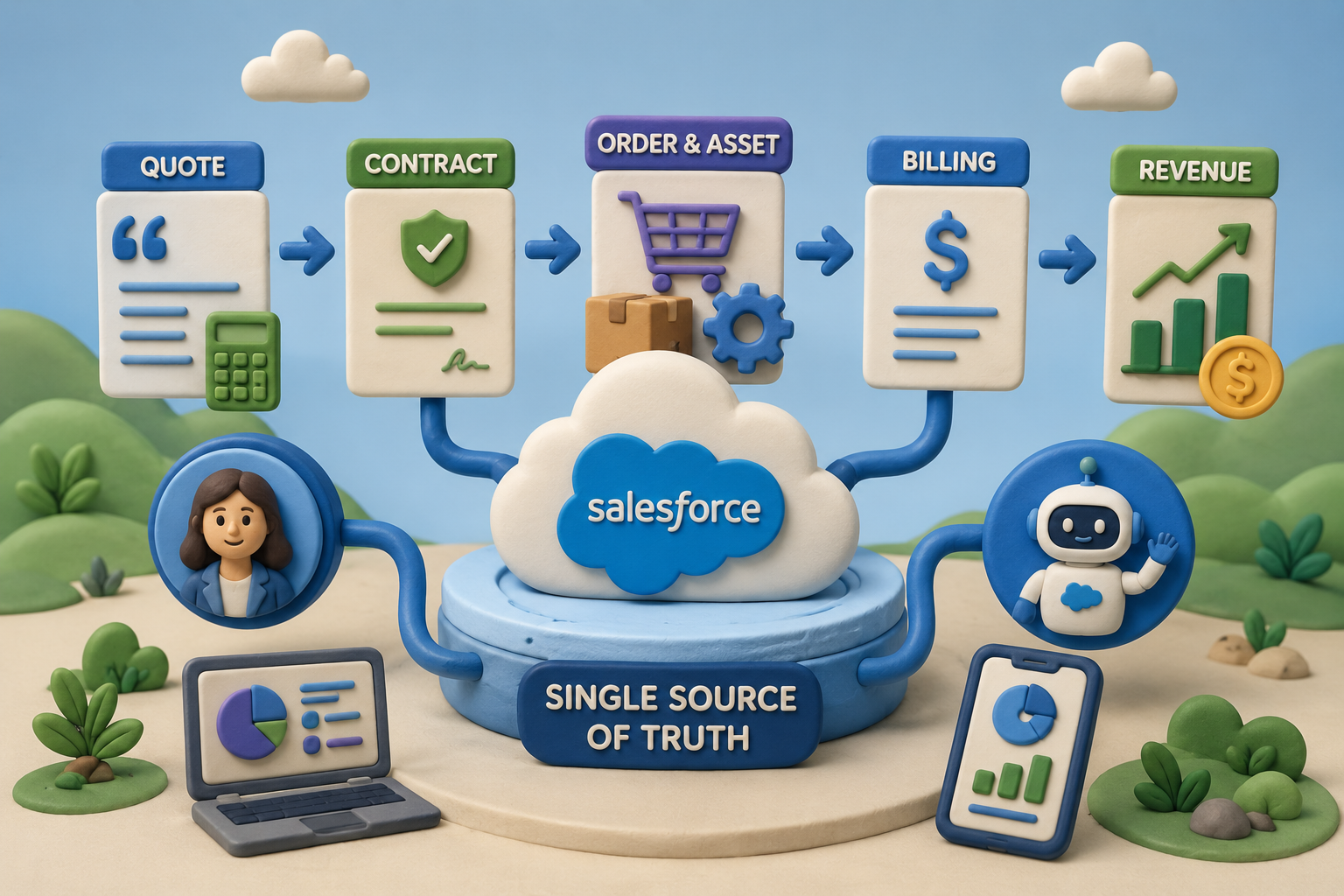
Quote-to-Cash Needs a Single Source of Truth
Salesforce defines Single Source of Truth (SSOT) as:
“A data architecture concept designed to ensure that every person in an organisation bases business decisions on the same, unified data set. It is the practice of structuring information so that every data element is mastered in one place, providing a reliable reference point across the entire enterprise.
Many mistake it for a data governance concept. It is not. Because it has a direct impact on how revenue flows through your business. Let us go back to earlier examples: the recurring discounts and lost contract amendments. None of these failures happened because the commercial terms were wrong. No, they happened because each downstream system was working on its agreement version. .
A Single Source of Truth changes that. It doesn’t recreate customer or contract information at every stage of quote-to-cash. It carries the same commercial record from quote to renewal. Every team references the same underlying data.
This consistency has multifold benefits. Quote accuracy. Reduced manual reconciliation. Lower revenue leakage. Above all, confidence for different teams that they're working from the same information.
Switching from CPQ to Agentforce Revenue Management the “Right Way”
If you plan to migrate to Agentforce Revenue Management, there is one mistake you should be wary of - Design it only as a CPQ enhancement.
Many organisations approach the migration with one of the two objectives below:
- Replicate the existing quoting process
- Migrate the product catalogue and retire the legacy CPQ package.
This will reduce disruption in the short term, no doubt. But it will also limit the value of your platform.
You need to understand that Agentforce Revenue Management is designed to manage the entire commercial lifecycle, not just the creation of quotes. Product catalogues, pricing, contracts, orders, billing events, amendments and renewals all become part of a connected process rather than separate hand-offs between teams.
That means the implementation should always begin with your business processes. Not screens. Not configuration. Before migration, you need to ask questions such as:
- Where do commercial terms change after a quote is accepted?
- Which teams recreate customer or pricing information manually?
- How are amendments reflected in billing and renewals?
- Where do revenue leaks or reconciliation efforts occur today?
Answering these questions truthfully will help you design a successful process. One where information flows once through the entire quote-to-cash lifecycle. Not recreated at every stage.
Most of our successful implementations were not about replacing CPQ. We redesigned how commercial data moved across different functions ( sales, finance, operations…). We made sure every team works from the same commercial record. And Agentforce Revenue Management delivers amazing value in this regard.
What You Will Experience After the Migration?
Several things!
- Quotes will flow faster. Because you know what a customer has directly. No dependency on admins.
- Renewals will become more accurate. Everything is generated from live data.
- Invoicing will become super-quick. There is nothing to reconcile with the finance team’s records.
- Partners and self-service portals will become viable options. Pricing logic can be exposed through APIs to channels.
All of these lead to actual(and accurate) decision-making. And that is why we strongly believe in this -
“Revenue operations and quote-to-cash management have indeed become one in the last two years.”
There is one more key point we didn’t mention. None of these improvements came from additional functionalities. It was simply the result of removing a handoff from the process.
How Can We Help You?
At Brysa, we acknowledge one thing. CPQ is invaluable. Especially for those needing reliable quoting. But industries are evolving. Many of them have moved towards subscription models and post-sale automation. And that’s why you need something like Agentforce Revenue Management. Why? Because it can handle more than just quotes. If you are using CPQ and want to migrate to Agentforce Revenue Management or are starting from scratch, we can help. Contact us now to talk it through with our Salesforce consulting team.