

Token prices are falling. LLM usage is growing. Yet, most businesses are exceeding their AI budgets. We didn’t say this. A McKinsey survey says so. According to it, 93% of organisations have exceeded their planned AI budget, and managing this has become a key priority for them.
Now, contrary to popular beliefs, the value of tokens going down ≠ lower bills. Because it often contributes to higher usage. Every new Copilot or every new AI agent adds to your running AI meter. And, no, unlike a license, most don’t sign off on it in advance. Now this is not a spending problem. It’s a shift in how growth gets funded. Now, before we look into the three costs of today’s growth equation, let us understand the older and simpler growth equation - more revenue = more people.
The Old Growth Equation & Why It Broke
Let’s go back a decade. Imagine you are adding a new market. Or a new segment. Or even a product line. To execute this, you need more salespeople and team members in other functions. In other words, your team size grew along with your revenue. Hiring was the accelerator, payroll, the petrol. There was software, of course. But it just supported the work. Licences for these tools were always bought per seat. In other words, the tool also grew with the number of people.
But once AI entered the picture, this equation became obsolete. Models and agents could analyse and execute processes without adding people. Put simply, output can grow. Headcount need not.
But don’t think the cost just vanishes. It just sifts. Or rather, spreads. The leaders who used to focus only on hiring people now manage three things:
- Hiring people
- Seat-based software
- Usage-based AI
All 3 are budgeted differently. And all 3 are approved differently. Which means the old growth equation can no longer account for all three together.
Also read: How to Make Your AI Investment Actually Work This Year
The New Growth Equation
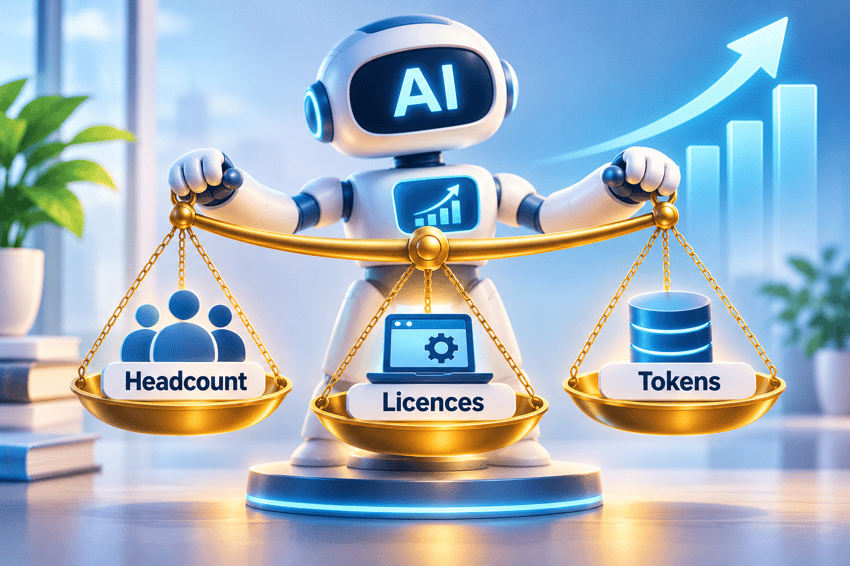
Look at it this way. The old equation was a straight line. More revenue means more people. The new one isn’t. Growth now depends on how you mix three inputs (people, licences and tokens). Revenue no longer rises in step with headcount. It rises with how well you split the work between the three elements. So, the new growth equation is effectively:
Growth = Right blend of headcount, licence spend and token spend
This changes the question you need to ask yourself. It’s no longer “how many people do we need to hire?”. It is “which of the 3 should do this piece of work?” Get it right and output grows faster than cost. Get it wrong and you end up with a full payroll, idle licences and a runaway token bill all at once. Before we help you understand how to find the perfect balance, it is important to know how the three elements behave.
Three Different Costs of Today’s Growth Equation. Three Different Behaviours
As you saw earlier, the old growth equation revolved around one cost. But the new one tracks three. All three of them behave completely differently:
Headcount Costs
Almost every leader understands this well. It obviously grows in steps. You hire a person. Then you hire another. All of them are given salaries and benefits. There is onboarding time. It’s also sticky. Which means once you hire someone, reversing that decision is slow and expensive. But people bring 2 things that no software or AI platform (at least today) can. Judgment and accountability. That’s why headcount is still included as a key component in the growth equation. You cannot eliminate the importance of relationships and high-stakes decisions.
License Costs
This is the more predictable one. You pay per seat and you can forecast it down to the penny. The risk is negligible. Most buy licenses in bulk. The downside - low adoption (half the team never opens the tool. And many add layers of paid AI features and overlapping tools on top. While they may be useful, organisations end up paying twice for the same job. The tricky part is licenses rarely shoot up the costs in one go. It increases it slowly and most never realise it until it is too late.
Token spend
At Brysa, we call this the wild card. You pay per use. The cost rises with every prompt. Every agent run and every retry reduces your coffers. Since each unit is cheap, it easily gets out of hand for most teams. A single workflow can result in multiple calls. And nobody has to approve any of them. The bill simply arrives on a random Monday.
Also read: How to Make the Best Out of Your 2026 AI Investment?
A Framework for Allocating the Next Pound in AI-Led Growth
Here’s a five-step framework you can run with your own team:
- Start with tasks. Not roles. Break each team’s work into specific tasks. For instance, drafting reports. Or reviewing contracts. Asking “do we need this person?” hides what the work involves. Asking “which tasks make up this role?” shows you where the real choices are.
- Classify each task. Ask four questions of every task. Does it need judgment? Is it repeatable? Does it run at high volume? Is the risk of getting it wrong high? The answers point you to the right lever.
- Match the task to a lever. Give judgment, relationships and high-stakes decisions to people. Give standard, predictable workflows to licences, where a ready-made tool already does the job. Give repeatable, high-volume work to tokens, where cost scales with use rather than with hiring.
- Measure output per pound. Compare what it costs to complete a task through each lever, including the hidden costs: onboarding time for people, unused seats for licences, and human review of AI output for tokens. Total spend per category tells you very little. Cost per outcome tells you where the next pound works hardest.
- Set guardrails. Add usage caps, per-team token budgets and spend alerts. Cheap tokens can quietly become the most expensive line item, and a guardrail is the only approval step this cost type has.
|
Type of work |
Best lever |
Why |
|
Strategy, negotiation, client relationships |
Headcount |
Needs judgment and accountability |
|
Standard workflows (CRM, design, project tracking) |
Licences |
Predictable and ready-made |
|
Drafting, summarising, support queries at volume |
Tokens |
Scales without hiring |
How Can Brysa Help?
Finding the right mix of headcount, licences and tokens needs a clear view of how your teams actually work. At Brysa, we study your workflows first. Only then we automate your repetitive work using AI. We help you assess your AI readiness. Put Agentforce and workflow automation to work where they make sense. And integrate your platforms so that you have a unified view of cost and output. The result - a perfect mix that gives great returns on your budget. Contact us to know more