

A good chunk of today’s businesses use 5 -15 AI tools. But only half of them have a central registry of what those tools can access. And only one or two have a kill switch policy. The agents run 24 X 7 without supervision. And without governance. When you ask them the following 5 questions, the answers are unconvincing, to say the least -
- What AI agents do you have?
- What can they do?
- What data and systems can they access?
- Are they operating safely?
- Are they creating business value?
An AI control tower helps them answer these questions accurately, as it has a unified view of their AI ecosystem. In this guide, we will understand what an AI control tower is and why one needs it before deploying autonomous agents.

What is an AI Control Tower?
An AI control tower answers the 5 questions we discussed earlier. But its simple definition is a central governance and operations layer for enterprise AI. Do not confuse it with a dashboard. It serves a much bigger purpose than that. It lets you perform the following tasks more confidently:
- Discover AI agents
- Classify risk
- Assign ownership
- Approve access
- Monitor activity
- Measure outcomes
- Decide whether to change or retire an agent.
5 Dimensions of an AI Control Tower
An AI control tower is built on five core dimensions that work in tandem to keep your autonomous agents accountable.
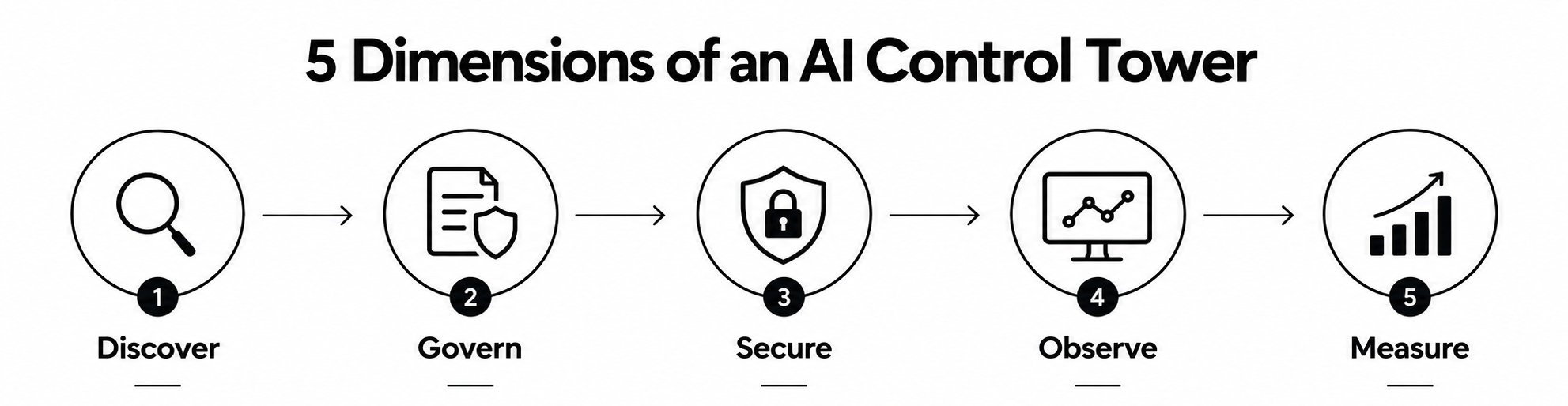
- Discover: Maintains a live inventory of every agent running across your business. This includes what data it touches and what systems it can act on.
- Govern: Sets the rules of engagement. This includes permissions and boundaries so that your agents can operate within policy rather than making unchecked decisions.
- Secure: Protects against the new class of threats agents introduce (prompt-injection attacks, data exposure, etc.). This ensures every interaction is authenticated and every access point is locked down.
- Observe: Gives you a real-time window into agent behaviour. This is not only about logging after the fact. This is about offering live visibility into what agents are doing right now and why.
- Measure: Closes the loop by tracking performance and outcomes. This way, you know whether your agents are actually delivering value or quietly draining your resources.
Why Do You Need an AI Control Tower?
You don't need an AI Control Tower because agentic AI is dangerous. You need it because AI is becoming powerful. It’s obvious - the more your agents can do, the more important it becomes to define clear boundaries. A good control tower helps create proportional governance. For instance, setting lightweight oversight for read-only assistants and stronger controls for agents that recommend actions or execute tasks.
Apart from this, AI budgets are surging. Your leaders won't accept vague promises forever. They will want clarity on which agents are actually reducing handling time or which ones are improving resolution rates. A control tower will make the capabilities of your AI agents measurable. It will turn a scattered collection of agents into a portfolio that can be managed like any other business capability.
The numbers also show opportunities. Gartner predicts that by the end of 2026, 40% of enterprise applications will include task-specific AI agents. This is a steady rise from less than 5% in 2025. At the same time, Gartner expects more than 40% of agentic AI projects to be scrapped by 2027 due to rising costs or weak risk controls. The message is clear. Autonomous agents are spreading fast in all directions. But many initiatives will collapse without proper governance. And that’s why establishing an AI control tower is critical today.
How to Build an AI Control Tower for Your Business?
Don’t wait until your autonomous agents become a crisis that you discuss in your board meetings. Follow the steps below to successfully build your AI control tower before you add any more autonomous agents to your operations:
Step 1: Build an AI Agent Inventory
Catalogue every agent in your business. Each entry should include purpose, data access profile, connected systems, autonomy level, approval path, and success metrics. Don’t proceed without setting this baseline. Because without it, you will never know how AI is impacting your organisation, let alone govern it.
Step 2: Define Governance Tiers
You may have 10 agents in your inventory. But not all of them pose the same risk. So you don’t have to govern all of them in the same uniform way. If you have a read-only agent or an advisory agent, the boundaries can be more relaxed. But for workflow-triggering or fully autonomous agents, the guardrails and governance policies have to be stricter.
Step 3: Get Enterprise Data Ready
Your agents are good if the context given to them is good. That’s the thumb rule. This means your data around users, roles, services, assets, applications, policies, knowledge articles, and workflow history all need to be in order. Weak data produces weak agents. Governed data gives your agents and AI control tower a more reliable foundation to act on.
Step 4: Measure Value Continuously
Track your agent performance on an ongoing basis. Not every agent deserves to stay in production as-is. Some will need refinement. Some retirement. Continuous measurement is what separates agents that deliver real value from ones running on assumptions.
Where Agentforce Fits Into the AI Control Tower Conversation?
Salesforce's Agentforce is one good example of why we are having this entire conversation about the AI control tower. Agentforce lets you deploy autonomous agents directly inside your CRM. And these are not the basic assistant-style AI agents most teams are used to. What this means is that it raises the stakes on everything discussed above.
Now, the effectiveness of an Agentforce agent is always based on the underlying data and workflows. If your access controls are loose or your knowledge base is inconsistent, the agent will bring in all that fragility into its operations. This is why data readiness and governance aren't optional prerequisites for Agentforce anymore. They're the foundation an AI Control Tower is meant to design before autonomy is switched on.
How Can Brysa Help?
Most businesses trying to deploy Salesforce Agentforce run into the same wall. Their data is scattered. Their permissions are loosely defined. No on mapped out what an agent should ( or shouldn't ) do…. That's exactly the gap Brysa closes.
We don’t jump straight to automation. We first evaluate whether your Salesforce workflows and access controls are actually solid enough to support autonomous agents. We dig into your platforms and processes and identify those that are stalling your agentic AI rollouts. Finally, we start cleaning up your data and building governed workflows. In other words, we build the discipline a Control Tower requires: visibility before autonomy and governance before scale. So, if you are looking to deploy AI agents without the guesswork of "what happens if this goes wrong," contact us now.