

Many businesses make the same mistake. They rate their own position on an AI maturity model higher than the evidence supports. We’ve personally questioned many CXOs regarding the same, and their answers are usually skewed one stage ahead of what a neutral outsider would say. There are two reasons why this is hugely problematic. One, you are never going to fix a gap that you believe never existed in the first place. Two, it completely distorts what success means to your business when it comes to AI adoption. In this guide, we are not only going to explain what an AI maturity model is, but also help you find where your business stands and how to move ahead in this model.

What is an AI Maturity Model?
Most materials you find on the internet define it as ‘how far your business has come in terms of AI adoption’. But this is far too simplistic a definition and confuses activity with maturity. The proper definition is ‘how well your organisation is prepared to adopt and scale AI capabilities over time and reflects the company’s progression from experimentation to value-driven use of AI '.
An AI Maturity Model is helpful particularly for three types of companies.
- Who has a stalled pilot stage and is unsure how to scale.
- Who has built an AI project without building the right foundation
- Who wants to set realistic AI goals and plan the next steps toward scalable impact.
The model gives the necessary clarity for such companies on the tools, skills, and commitment required from the leadership to move on to the next stage of the AI Maturity Model.
5 Stages of an AI Maturity Model
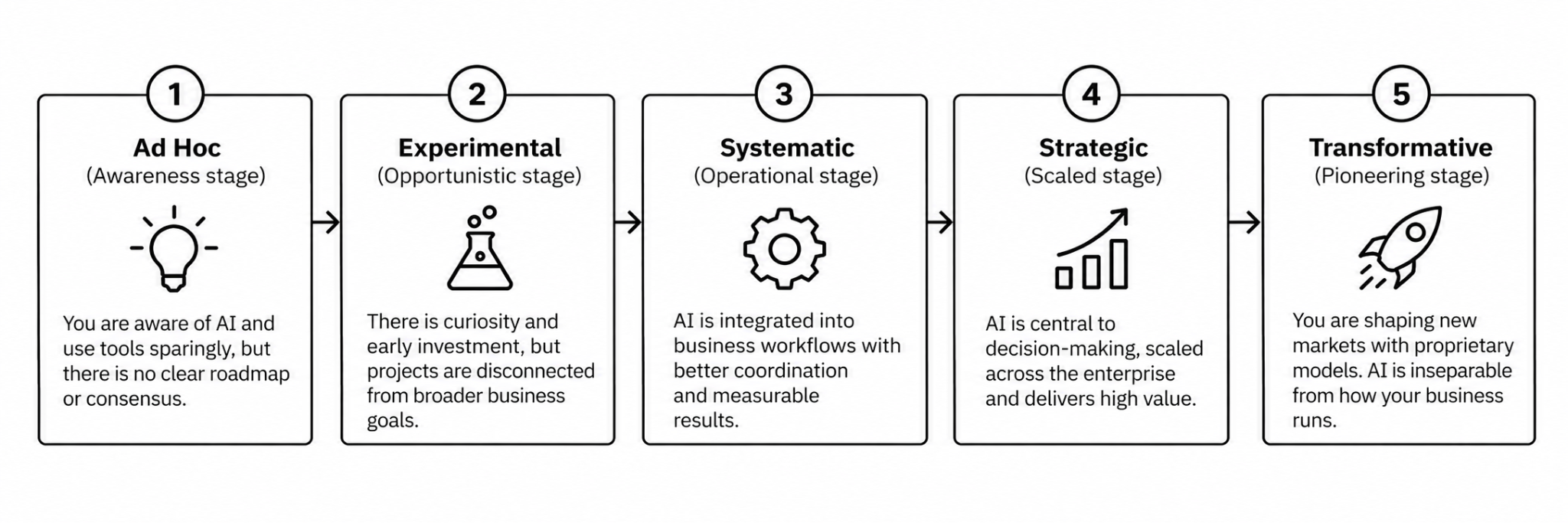
Stage 1: Ad Hoc
This is the stage that most businesses that are dipping their toes in AI fall into. This is also called the Awareness stage. You are aware of AI and even use various AI tools sparingly. You may discuss systematic adoption during meetings and even play with pilot ideas. But there’s no clear roadmap or consensus on what success actually looks like. Ask anyone in your company, and they will not be able to specify a single AI project with a budget and an owner attached to it.
How to identify if you are in the Ad Hoc stage of the AI Maturity Model?
- Your pilots are driven by hype
- You have not defined any clear success metrics
- You have made limited investment in AI initiatives
How to move up to the next stage of the AI Maturity Model?
Design a basic AI strategy with clear business goals and set up pilot programs with measurable outcomes.
Stage 2: Experimental
This stage is aptly called the ‘Opportunistic stage’ because there is sufficient curiosity and early investment in possible opportunities involving AI in key functional areas of the business. However, there is a severe lack of coordination, and all the projects are disconnected from broader business goals. Your AI efforts are highly reactive, and there are basic data governance practices in place.
How to identify if you are in the Experimental stage of the AI Maturity Model?
- You have successfully launched pilots in specific business functions like sales, marketing, operations, IT, etc.
- You have experienced success in some projects and failures in others
- You have made sufficient initial investment in AI platforms
How to move up to the next stage of the AI Maturity Model?
Build an enterprise-wide AI strategy that is tied to your business goals, plus standardise your data processes and governance structures.
Stage 3: Systematic
This is the stage where AI is no longer part of your experiments or side projects. This stage is also called the ‘Operational stage’ and rightly so, as it is tightly entangled in the way your business operates. You find that your efforts around AI projects are better coordinated, and you have even started building reusable components. You are regularly holding formal discussions around data governance, and you begin to see measurable results and ROI from your AI systems.
How to identify if you are in the Systematic stage of the AI Maturity Model?
- You have integrated AI into several business workflows, and it is showing impact
- You have invested in AI internal expertise and knowledge sharing
- You have stronger data governance and security practices.
How to move up to the next stage of the AI Maturity Model?
Keep investing in scalable AI infrastructure and build clean data pipelines to ensure accurate insights.
Stage 4: Strategic
In this stage, AI is part of your business decision-making and is central to competitiveness. You have successfully scaled AI across your enterprise, and there’s perfect sync between your technical capabilities and business strategies. And that’s why this stage is also called the ‘Scaled stage’. All your AI systems are fully optimized and deliver high value. Each system generates valuable and actionable insights that directly impact your profitability.
How to identify if you are in the Strategic stage of the AI Maturity Model?
- Your investments in talent and AI systems are intentional and sustained
- You have dedicated teams or centres of excellence
- You have a culture of continuous improvement in AI initiatives
How to move up to the next stage of the AI Maturity Model?
Continue to refine your AI models and build an agile culture where AI solutions can be adapted and optimized quickly. Keep investing in advanced AI capabilities like machine learning and deep learning.
Stage 5: Transformative
You are a pioneer now, and that’s why this stage is also called the ‘Pioneering stage’. Thanks to AI, your business is shaping new markets, and you are building proprietary models. You are pushing the boundaries of AI and contributing greatly to research and regulation. AI is inseparable from how your business actually runs. This includes creating newer patterns like autonomous agents making decisions within defined limits.
How to identify if you are in the Transformative stage of the AI Maturity Model?
- You have custom AI innovations driving new revenue streams
- You have built deep integration of AI with product development
- You have integrated ethical AI frameworks
Tech That Can Help You Move Forward in the AI Maturity Model
Once you identify the stage you are in the AI maturity model, your immediate next task is to invest in tools that can help you move forward in the curve. The Salesforce ecosystem offers Einstein and several other AI-embedded CRM features, making it a low-risk way to test AI in sales and marketing workflows, particularly when you are in Ad Hoc or Experimental stages. Once you enter the Systematic stage, you need to focus more on consolidating customer and operational data, and that’s where Salesforce can help greatly.
When you enter the Strategic stage, Agentforce enters the picture. By now, you have all the data governance and internal expertise needed to safely deploy autonomous AI agents. Agentforce allows these agents to handle many of these defined tasks with human oversight built in. And by the time you reach the final stage, Agentforce-style agents are often not just assisting your employees. They're independently executing multi-step processes end-to-end. All this is done with ethical and operational guardrails clearly defined by you and your team.
Close the AI Maturity Gap with Brysa
At Brysa, we help you avoid wasted AI investments by helping you based on where you are on the AI maturity model. We focus only on what actually moves the needle and don’t follow a one-size-fits-all process. From day one, we will design actionable roadmaps to close your AI maturity gaps thanks to our deep expertise in AI consulting and implementation. Ready to take your AI maturity to the next level? Contact us today.